The breathing air in every cylinder you fill starts as the ordinary air around your compressor. Before a diver breathes that air, it has to be clean, dry, and at the right pressure.
A breathing air compressor works by drawing in ambient air and raising its pressure step by step, cooling the air and removing water between steps. The oxygen and nitrogen mix stays at roughly 21% and 79%, so the quality of each fill comes down to the contaminants removed or picked up across five steps, from the air intake to the cylinder.

Source image: Adapted from Peter Southwood’s three-stage high-pressure breathing air compressor schematic, licensed under CC BY-SA 4.0. Simplified and redesigned for this article; component layouts vary by compressor model.
Step 1: Air Intake
A breathing air compressor starts by drawing in ambient air through an intake filter. This filter catches dust and other particles before they reach the first compression stage, so clean it at the intervals set out in your compressor's manual.
Clean intake air starts with where the compressor stands. Set it up away from engine exhaust, oil mist, and aerosols, because exhaust gases can carry carbon monoxide into the intake. Keep the compressor's own exhaust opening clear and clean as well.
Step 2: Multi-Stage Compression
A high-pressure breathing air compressor raises the air's pressure in steps. Most have three or four stages. The air leaves one stage at a higher pressure and enters the next to be compressed again, until it reaches the filling pressure.
Low-pressure diving compressors usually have a single stage, because their delivery pressure is relatively low. In a high-pressure compressor, each stage raises the temperature of the air as well as its pressure. For this reason, the air is cooled between stages before it moves on.
Step 3: Cooling and Moisture Separation
After each compression stage, the hot air flows through a cooling coil, called an intercooler, before it enters the next stage. Cooling the air improves the efficiency of compression. It also raises the air's relative humidity, so part of the water vapor condenses into liquid.
A separator after each intercooler collects this liquid. Inside the separator's wide vertical tube, the air slows down, and water droplets drop out of the airflow and collect at the bottom. In an oil-lubricated compressor, the separator also catches oil droplets. The drier air then moves on to the next compression stage, where cooling and separation happen again.
The condensate stays in the separator until it is drained through the drain valve. Drain it at the interval in your compressor's manual, which can be every few minutes during a fill. Open the valve slowly and wear eye and hand protection, because the condensate comes out under residual pressure.
Step 4: Final Air Purification
After the last separator, the air still carries water vapor and can carry traces of oil and other contaminants. Before it reaches the filling hose, it passes through one or more filter cartridges in a high-pressure filter housing. Each cartridge holds layers of filter media, and the air passes through them in a set order, starting with the layer that removes water.
Drying the Air
The first layer is a desiccant, often a molecular sieve. Water is removed first because it reduces the effectiveness of some of the other media. Some grades of molecular sieve can absorb up to 23% of their own weight in water, and the dry air that results also reduces corrosion inside diving cylinders.
Removing Carbon Monoxide, Oil Vapor and Odors
If there is a risk of carbon monoxide in the intake air, the next layer is a catalyst called hopcalite, which converts carbon monoxide into carbon dioxide. Hopcalite only works in very dry air, which is why it comes after the desiccant. Activated carbon follows and absorbs oil vapor and removes odors. A final particle filter then catches dust released by the filter media.
A compressor without oil lubrication still needs this filtering, because the intake air carries water vapor and can carry other contaminants. We compare both designs in Oil-Free vs. Oil-Lubricated Scuba Compressors.
Keeping the Filter Cartridge Effective
Each layer in the cartridge has a limited capacity, so the cartridge has to be replaced on a schedule. Ambient temperature has a strong effect on that schedule. Warm air holds more water, so the desiccant saturates faster on hot days. In one compact 200-bar (2,900 psi) compressor, for example, the minimum cartridge life is about 34 hours at 10 °C (50 °F) and about 11 hours at 30 °C (86 °F). Log the running hours and the temperature to know when the next cartridge is due.
Between replacements, the cartridge also needs the right pressure to work. A back-pressure valve at the filter outlet holds the housing under pressure, which gives the media enough contact time with the air. Keep this valve correctly set, and keep the housing pressurized between fills. Store new cartridges in their sealed packaging until installation, and replace an opened cartridge within six months even if it has hours left.
Step 5: Pressure Control and Cylinder Filling
The purified air travels through a high-pressure filling hose into the diving cylinder. Before you start, set the final pressure on the compressor's pressure gauge to the filling pressure given in the cylinder manufacturer's documentation.
When the cylinder reaches that pressure, the compressor shuts off automatically or an overpressure valve limits the fill, depending on the design. Overpressure valves on the compression stages also release air if the pressure rises above their setting. Some compact compressors carry two safety pressure relief valves, so if one fails, the second still releases the excess air.
The filling hose, often called a filling whip, has a filling valve to open the flow and a purge valve to release trapped air before you disconnect it. Some hoses connect with a quick-connect coupling that releases residual pressure when it is disconnected. The coupling also closes if the pressure drops suddenly, as it would if the hose ruptured.
Fill only cylinders that are approved for the set pressure and have a valid inspection. Check the safety valves, the pressure gauge, and the automatic shut-off at the intervals in your compressor's manual, because these parts protect both the cylinder and the person filling it.
How Is Breathing Air Quality Verified?
You verify breathing air quality by testing samples of the compressor's output against a breathing air purity standard at regular intervals. In Europe, the reference is EN 12021. It sets limits for oxygen, carbon monoxide, and carbon dioxide, along with oil and water content. The air must also have no unusual odor or taste.
Of these limits, only odor and taste can be checked without instruments. The other contaminants need a test to measure them, because some give no warning at all. Carbon monoxide is odorless, colorless, and tasteless, so a contaminated fill can smell exactly like a clean one.
The required testing interval, the contaminants to analyze, and the allowable limits vary between applications and countries. Follow the requirements that apply to your operation, and keep each test result with your compressor's maintenance records.
Match the Compressor to the Fills You Need

The right compressor for your operation depends on your cylinder sizes, your daily fill volume, and where you plan to install it.
A compact compressor such as the Nano HP15 fills to 200 bar (2,900 psi) at 15 L/min, which suits boats and smaller operations. Since 2000, we at NRC International have built German-made breathing air compressors and Nitrox systems for operators in over 35 countries.
You can find replacement filter cartridges and other consumables in our compressor accessories. If you are not sure which setup fits your operation, contact us, and we will help you plan it.
Frequently Asked Questions
Can a breathing air compressor fill Nitrox?
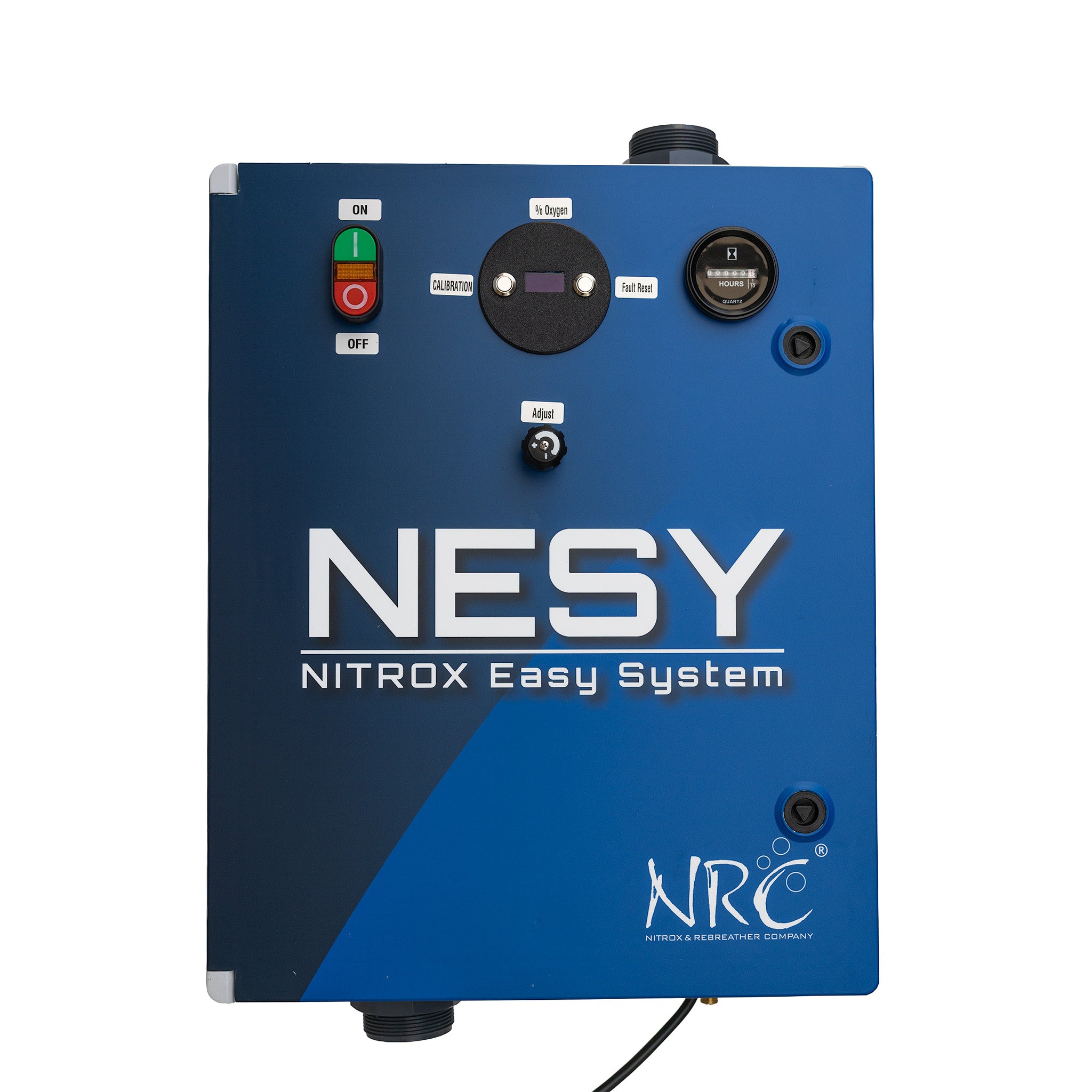
Only if the compressor is approved for Nitrox, and only up to 40% oxygen. Compressing oxygen-enriched air above 40% oxygen, or pure oxygen, in a high-pressure breathing air compressor can lead to fires and explosions. Some compact compressors are not certified for Nitrox at all. If you need Nitrox, use a dedicated Nitrox system such as a membrane system, and make sure the compressor that fills the cylinders is approved for Nitrox.
How long does it take to fill a scuba cylinder?
The fill time depends on the cylinder's size, the fill pressure, and the compressor's filling rate. To estimate it, multiply the cylinder volume in liters by the fill pressure in bar, then divide by the filling rate in liters per minute. For example, a compressor filling at 15 L/min takes about 160 minutes to fill an empty 12-liter cylinder to 200 bar (2,900 psi).
How often does a breathing air compressor need servicing?
Follow the intervals in your compressor's manual, based on running hours and calendar time. On a compact compressor, for example, a qualified person inspects the safety valves and tests the pressure shut-off once a year. Every two years, the compressor also gets a functional test, a leak test, a lubricant change, and gauge calibration.